
CUDA R/C R/G Pages |
|




| | | | | | | | | |
| Tail Assembly | |
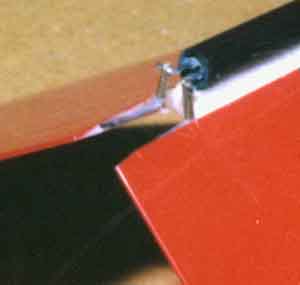
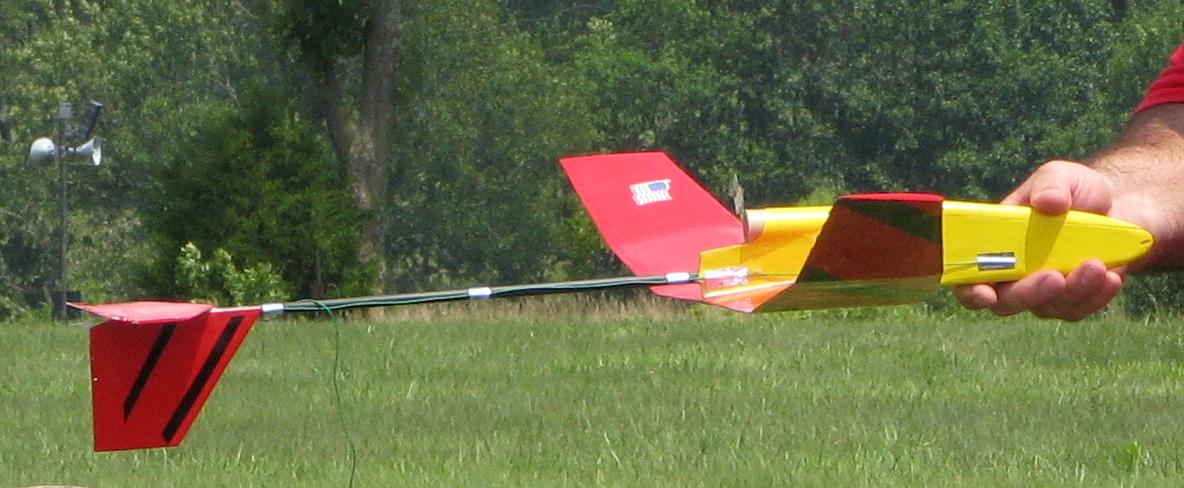
V-Tail As shown at right, a photo showing the detail of the control horns and pushrods. When I get more close-up tail detail photos from current Cuda owners, I will add them
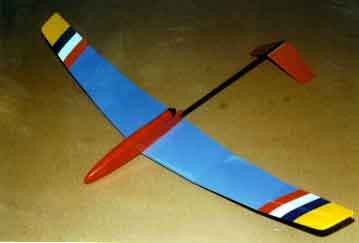
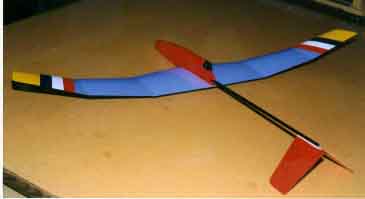
| T-Tail Option Unless you have done V-tails before, use the "T" tail option, as seen on Jim Filler's model at right. This is because the servo motion, and linkages and control horns have to be dead equal between left and right. If not, then you will have up elevator introduce some unwanted turning, or right rudder causing some unwanted pitch response. |
|
|

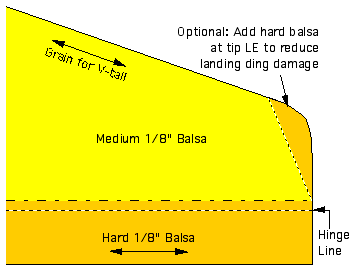
| 1/8" Balsa Tail & Airfoil The Cuda was designed to have a fully airfoiled tail. In reality, most people do not have the patience and/or skill, to sand the airfoil that much. This is also a contributing reason for Cudas to tun out tail, heavy, a lot of the 3/16" balsa was not sanded away. I recommend replacing the 3/16" tail with 1/8" balsa. Either medium-hard sheet for the whole V-tail., or whole horizontal Stab, or better yet CA together some medium balsa for most of the stab to save some weight, and hard C-gain balsa for the last portion which will be sanded to a taper. The reason for using harder balsa there is so that the control surface will be plenty stiff, and not tend to twist under air loads on boost. Since it will be sanded to a taper, you will lose some of the mass of that harder heavier balsa. By only rounding the front, and tapering the back, you will be left with a significant part of the stab that will be flat. For the average flier, that is FINE. An extra benefit of this is that you will be able to align the tail incidence much more accurately than you could judge by eye with a fully airfoiled tail. |
|
|

| Tail Incidence If the wing mounting has been done correctly, the wing will be at zero degrees incidence angle to the boom. That is, the line drawn from the center of the leading edge , to the center of the trailing edge, will be at zero degrees to the boom, or parallel to the boom. The Cuda is designed for the stab to be at zero degrees to the boom as well. So, if the wing is at zero, then for a "T" tail, you can just glue the bottom of the Horizontal Stabilizer to the top of the boom. For a "V" tail, you can cut out a pylon that is rectangular, instead of the original curved one to match the designed tail airfoil. NOTE: If there is any error in the angle between the wing and tail it is better for the wing to be slightly positive compared to the tail, than for it to be slightly negative compared to the tail. Slightly positive will cause it to pitch nose-up, which can be trimmed out for boost with a bit of down-trim. And for glide you need to have some up-trim if the wing and stab are exactly parallel. | 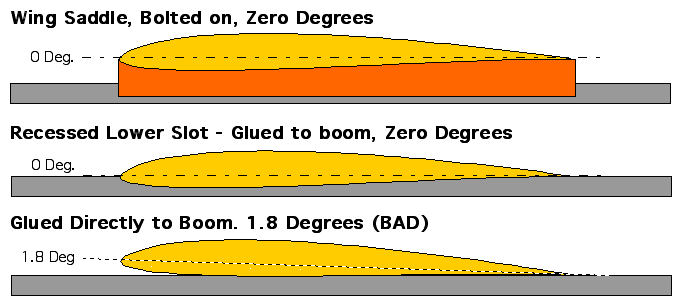 Examples of wing incidence, which should be zero degrees |